By Morgane Oger
On April 16, 2025, the UK Supreme Court ruled that under the Equality Act 2010, the definition of “woman” is restricted exclusively to biological sex assigned at birth.
Transphobic activists around the country such as JK Rowling and Maya Forstsater rejoyced at the news while Transgender advocates condemned the decision as one that puts the transgender community at risk.
The decision explicitly excludes transgender women, even those possessing Gender Recognition Certificates, from legal recognition as women. It also mixes sex and gender in the legislation, making it more difficult to interpret rights as it now inconsistently mixes sex, sexual orientation, and gender in the Equality Act 2010 in a way that strips it of clarity. Unclear laws causes misunderstanding which can result in conflict, and UK institutions now face excruciating questions about when sex is the factor and when gender is.
I expect many cisgender and transgender women will be harmed by the confusion. Particularly at risk are Intersex persons, women presenting in ways trans-obsessed onlookers will perceive as transgender, all trans people, and everyone accessing single sex spaces whose dignity and sense of safety is impacted by beliegerant with a penchant for enforcing the rules at the expense of others.
Consider for a moment how you will prove to an agitated person policing single-sex spaces you are not a predator lying about who you are.
You can’t.
I am a transgender woman, and my foundational ID documents state I am female. Yet I am publicly out and, clearly, quite loud about it. No legal documents exist that state I am or have ever been male. This is a situation many transgender persons from affirming countries are in: there is no distinction available to UK law between a cisgender or transgender man or woman from Canada. Or from most EU countries.
The UK will now need to clarify how it deals with situations such as mine.
To my eyes, this ruling is a deeply troubling regression that undermines the dignity and human rights of transgender individuals.
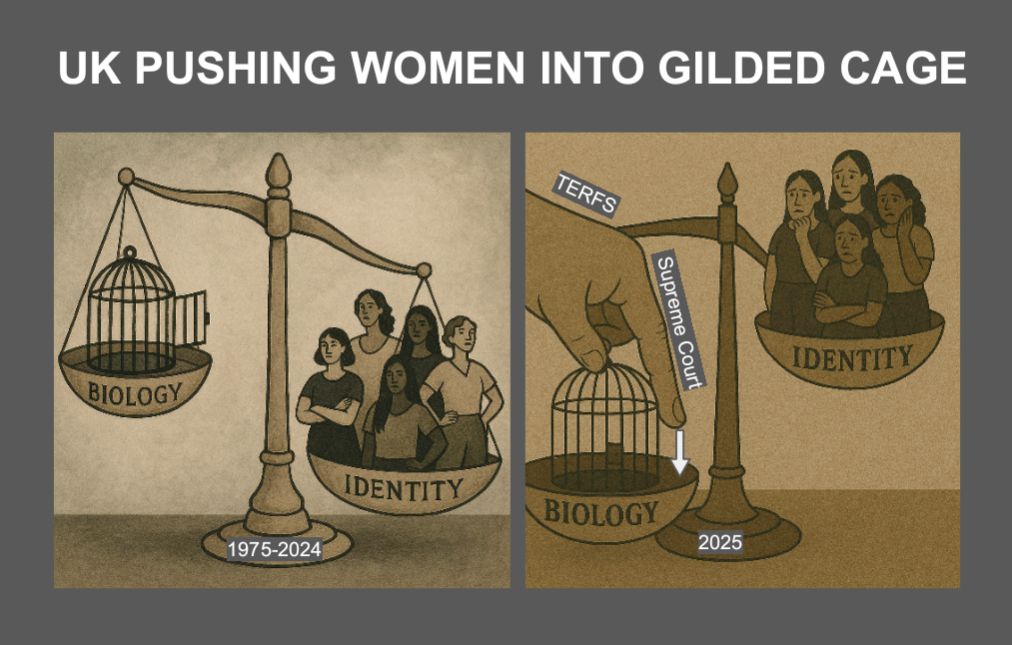
This UK Supreme Court decision aligns the country with nations enforcing rigid biology-based definitions of sex. Uganda’s 2023 Anti-Homosexuality Act criminalizes LGBTQ+ identities, while Hungary amended its constitution in 2020 to define gender based solely on birth sex, effectively barring transgender individuals from legal recognition.
In the US, the Trump administration has implemented executive orders based on a similar lens. The US now defines sex strictly based on biological sex assigned at conception, explicitly excluding recognition of gender identity. It withdrew federal protections and funding for transgender healthcare, restricted transgender participation in sports, and barred transgender individuals from military service. Trump’s policies have faced widespread criticism for undermining transgender rights and wellbeing.
These actions represent a bioessentialist viewpoint, asserting that biological sex alone defines gender identity, dismissing the reality and legitimacy of lived experiences.
Bioessentialism—the belief that biology alone determines gender roles and identities—reinforces restrictive stereotypes for all women, whether cisgender or transgender. It perpetuates outdated assumptions about women’s capabilities and roles in society, limiting opportunities and perpetuating discrimination. For transgender women, bioessentialism denies recognition of our identities entirely, creating legal and social barriers that erase our experiences. For cisgender women, it reinforces harmful stereotypes that constrain their personal and professional freedoms, reducing them to simplistic biological definitions rather than recognizing their full, diverse humanity. Women around the world fought for decades to overcome legislation holding them back over biological arguments. In Canada the Persons Case confirmed women’s eligibility for Senate appointments in 1929 despite being initially rejected by the Supreme Court of Canada. The ruling was overturned by the Judicial Committee of the Privy Council which agrees that women were, after, persons. This landmark ruling ensured women could not be denied rights through narrow legal interpretations whose echoes we can see in the UK ruling trans women as not women in matters of sex discrimination.
The European Union has rejected such frameworks for some time through inclusive policies and rulings. The landmark 1996 European Court of Justice case, P v S, recognized that discrimination against transgender individuals is a form of sex discrimination. By 2023, numerous EU member states adopted self-identification systems for gender recognition, prioritizing individual autonomy and identity over biological determinism.
I call upon the Canadian government to update travel advisories, categorizing the UK alongside countries with policies hostile to transgender individuals. While transgender visitors to the UK might receive some recognition there, the situation and safety situation needs to be clarified.
UK transgender citizens now face the cruel reality of identity erasure in their own country, and Canada needs to update our criteria for accessing asylum from countries such as the UK and the US as long as thry oppress transgender persons.
The international community also needs step up and respond decisively. The EU needs to reconsider the UK’s compatibility with its core values, and Canada has to clearly warn travelers about the UK’s regression on human rights and how being perceived possibly transgender in the UK is an increasingly serious safety concern that affects all Canadians travelling there.
Equality must never hinge solely on biology. It needs to take into account identity and perception.
—Morgane Oger is a Canadian transgender activist, political commentator, and human rights advocate.
 Morgane Oger
Leave a comment