Canada’s 2021 Census shows that 0.33 % of Canadians aged 15 and older—about 100,000 people—identify as transgender or non-binary.
Because every trans person is someone’s child, parent, sibling, or partner, demographic modelling suggests that around 3 % to 5 % of Canadians—1.2 to 2 million people—likely have a close family member who is transgender.
This is a calculated estimate rather than a census figure, but it illustrates how many households have personal connections to gender diversity.
If we add relationships at work, community, and school, this numbers grows even more.
Imported Rhetoric from the U.S. and U.K.
Despite all these ties, populist conservative movements in the United States and United Kingdom are exporting narratives that treat trans people as a public threat.
I’ve spoken up about this phenomenon before, and the problem is getting worse.
In the UK the 2025 For Women Scotland ruling narrowed the meaning of “sex” in the Equality Act to biological sex for certain legal purposes, fueling campaigns to restrict trans inclusion in single-sex spaces.
South of the border, the rhetoric is sharper.
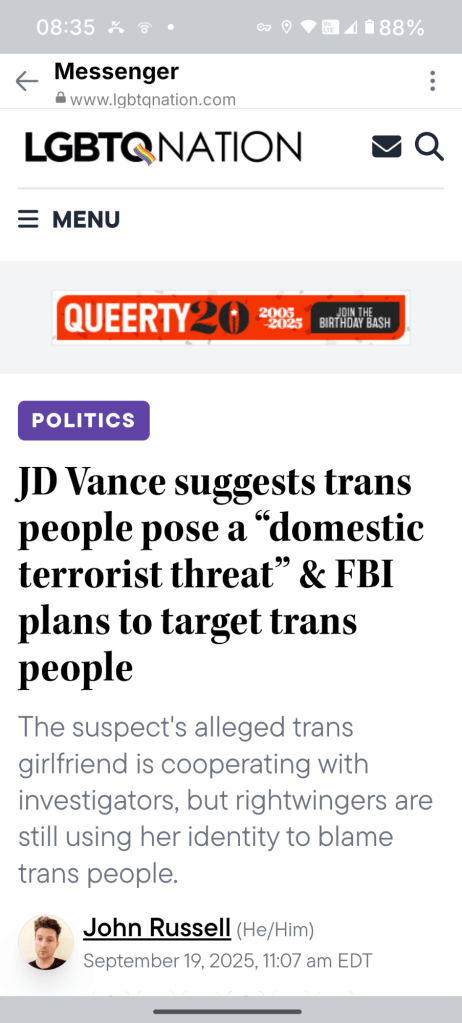
U.S. Senator JD Vance recently told Fox News that anyone “encouraging violence against the government or fellow Americans” under a “militant transgender movement” is “involved in a terrorist movement”
(LGBTQ Nation, Sept 19 2025).
Meanwhile, the Heritage Foundation’s Oversight Project is lobbying the FBI to create a domestic-terrorism category called “Transgender Ideology-Inspired Violent Extremism” (TIVE).
Federal officials have reportedly discussed classifying some cases under a broader “Nihilistic Violent Extremists” framework, but no U.S. agency has adopted TIVE or any policy singling out all trans people.

The Impact On Canadians
Canada is not immune.
Some politicians have echoed U.S. talking points:
- Alberta’s Bill 26, tabled in 2024, would restrict access to puberty blockers and cross-sex hormones for minors, framing gender-affirming care as “experimental.” to make this possible, Alberta premier Danielle Smith has been working on using notwithstanding clause to circumvent her own Province’s existing human rights law.
- School boards and provincial politicians in several provinces have proposed tighter rules on pronoun changes or classroom discussions of gender identity.
- A few MPs and party leadership contenders have questioned whether gender identity should remain a protected ground in human-rights law.
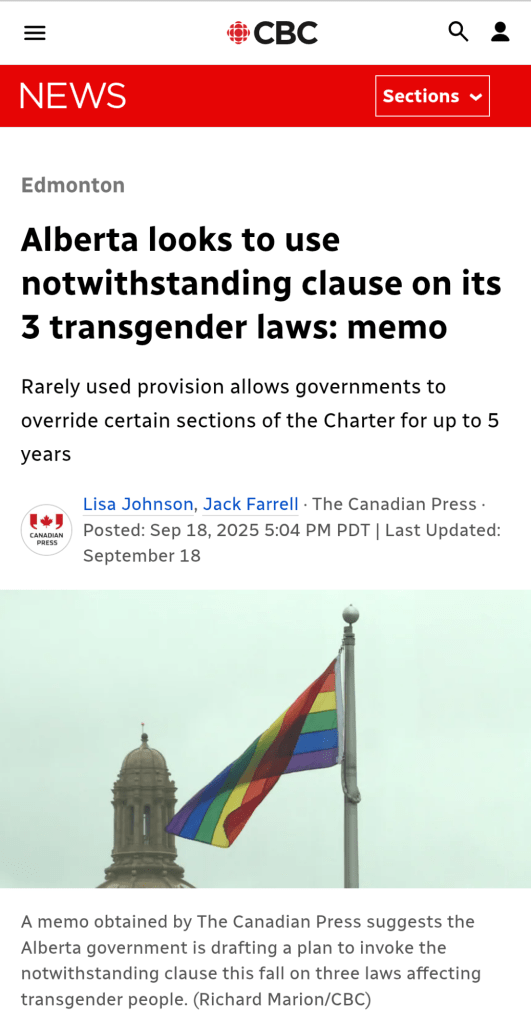
These measures remain more limited than the sweeping bans seen in some U.S. states, and Canadian medical bodies—such as the Canadian Paediatric Society—continue to affirm gender-affirming care as evidence-based and often life-saving.
Still, the political language is strikingly similar: warnings about “irreversible interventions,” calls to “protect children,” and appeals to parental rights.
OneBC’s Chief of Staff and Dog-Whistle Rhetoric
A striking example of this rhetoric emerged on September 20 2025, when Tim Thielmann, Chief of Staff for OneBC, a new right-wing party in British Columbia, posted on X:
“Men in dresses are welcome to attend our upcoming town hall in Penticton—just not to cancel it. Sorry gents, nice try!”
— X post
The phrase “men in dresses” is a well-known slur used to delegitimize transgender women and, by extension, drag performers.
It frames trans women as men intruding into women’s spaces and is widely recognized as dog-whistle language—a coded signal that resonates with audiences already primed to distrust or fear transgender people.
This remark came as OneBC faced a venue dispute: the Penticton Trade and Convention Centre had declined to host a OneBC town hall over inclusivity concerns and potential protests.
Party leaders and allies presented the cancellation as an attempt by “leftist activists” to silence them, a narrative common in U.S. and U.K. culture-war politics.
While OneBC has not yet issued a formal policy statement using this language, the fact that it comes from the party’s top staffer gives it political weight and shows how imported anti-trans rhetoric is being localized in Canada.
Why It Matters
When politicians or pundits portray transgender existence as a threat, they are talking about millions of Canadian families, not strangers.
Imported fear campaigns and home-grown imitators ignore the everyday truth that transgender people are integral to Canadian society.
Bottom line: Supporting transgender dignity and access to care is not a niche concern.
Worrying about the safety and the wellbeing of our family members and our loved ones is a mainstream concern close to the hearts of all Canadians.
Recognizing the scale of family connections is important for policy makers. With as many as 1 in 30 Canadian households related to a transgender person, the safety of transgender people is a personal worry to many more Canadians than some pundits would have us believe.
Understanding how some U.S., U.K., and now Canadian groups opposed to the acceptance of diversity and inclusion are interfering with Canadian life is important.
Canada’s social policy needs to reflect the priorities and the needs of all Canadians, and groups such as OneBC weaponizing fear and U.S. style politics are putting at risk members of our families. Deeply-biased voices chipping at the pillars of Canadian society that keep us strong and free are undermining our ability to uphold our shared values.
Imagine what Canada will look like if we weaken public health policy, if we do not defend workplace protections, if we strip away human rights law, if we drift away from reapectful fact-driven and values-centered dialogue.
These pillars of our social fabric work together to keep us all safe and thriving. They are essential to Canada’s social fabric working for everyone.
All our families and all our resilience are at stake if we allow mean-spirited regressive narratives to target Canadians as what is happening in the U.S. creeps into Canada. When far-right populism amplifies the deeply polarizing and divisive attitudes currently tearing apart the U.S., Canadians suffer.
I hope you will join me and all standing together saying “NO, not here” to imported divisive ideas designed to target people because they are somehow different.
A different faith. A different accent. A different skin colour. A different identity. A different postal code.
We are all different and such attacks target us all.
Inciting fear, disgust, or mistrust designed to targeting people because of who they are has always been an evil game.
It’s why Canadians implemented hate laws.
Sources: Statistics Canada 2021 Census; Canadian Survey on Disability 2022; Canadian Paediatric Society guidance; LGBTQ Nation (Sept 19 2025); reporting on Alberta Bill 26; The Tyee and CBC coverage of OneBC and Tim Thielmann’s X post.
 Morgane Oger
Leave a comment