Genocide is violence that targets individuals because of their membership of a group and aims at the destruction of a group of people. Stages of genocide were outlined by Gregory H. Stanton, the founder of Genocide Watch, in his model of the 10 Stages of Genocide (originally 8 stages, the concept was later expanded to ten).
Content warning: Historical genocides and review of anti-transgender hatred and targeting by U.S. Governments.
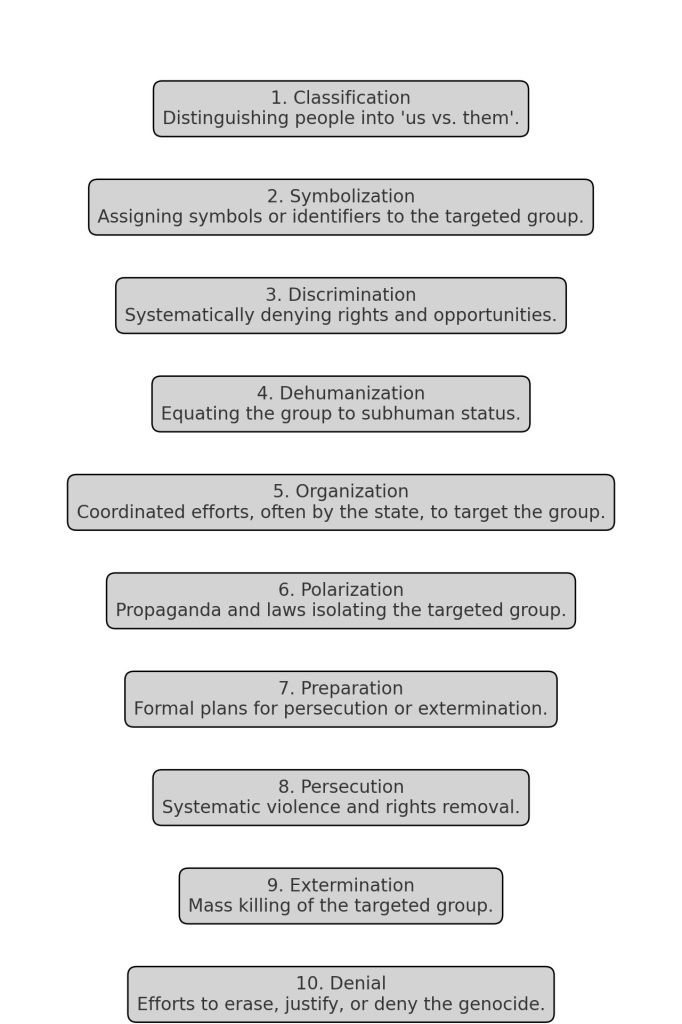
These ten stages are:
- Classification – Distinguishing people into “us vs. them.”
- Symbolization – Assigning symbols or outward identifiers to the targeted group.
- Discrimination – Systematically denying rights and opportunities.
- Dehumanization – Equating the group to subhuman status.
- Organization – Coordinated efforts, often by the state, to target the group.
- Polarization – Propaganda and laws isolating the targeted group.
- Preparation – Formal plans for persecution or extermination.
- Persecution – Systematic violence and rights removal.
- Extermination – Mass killing of the targeted group.
- Denial – Efforts to erase, justify, or deny the genocide.
Germany and the Holocaust (Targeting Jews, Roma, LGBT+, and Others)
- Classification (1933): Nazi ideology divided “Aryans” from Jews, Roma, and others.
- Symbolization (1935-1938): Jews were required to wear yellow stars, and Roma and homosexuals were also given identifiers.
- Discrimination (1933-1939): Laws like the Nuremberg Laws stripped Jews and Roma of rights. Homosexuals were criminalized under Paragraph 175.
- Dehumanization (1935-1942): Propaganda labeled Jews, Roma, and LGBT+ people as “vermin” and threats to society.
- Organization (1933-1941): The Gestapo and SS established systems for identifying and rounding up targeted groups.
- Polarization (1938-1941): Kristallnacht (1938) marked the first widespread violence against Jews. LGBT+ people and Roma were arrested in mass raids.
- Preparation (1940-1941): Ghettos and concentration camps were expanded. Roma and Jews were deported en masse.
- Persecution (1941-1945): Forced sterilization, medical experiments, and mass executions took place.
- Extermination (1941-1945): The “Final Solution” was enacted, leading to the Holocaust’s six million Jewish victims, with hundreds of thousands of Roma, LGBT+ people, and others also killed.
- Denial (1945-present): Holocaust denial persists in some circles.
Canada and the Genocide of Indigenous Peoples
- Classification (19th century): Indigenous peoples were treated as a separate, inferior class.
- Symbolization (19th-20th century): Indigenous identity was erased through forced assimilation.
- Discrimination (1867-1950s): The Indian Act (1876) restricted Indigenous rights.
- Dehumanization (19th-20th century): Indigenous peoples were seen as “savages” needing “civilization.”
- Organization (1880s-1990s): The government and churches coordinated Residential Schools and the Sixties Scoop to forcibly remove Indigenous children from their families.
- Polarization (1870s-1990s): Propaganda justified mistreatment. The Catholic Church and state labeled Indigenous spirituality as “paganism.”
- Preparation (20th century): Indigenous communities were forcibly displaced to reserves.
- Persecution (20th century-present): Forced sterilizations, missing and murdered Indigenous women (MMIW), and child apprehension programs continued to target Indigenous peoples.
- Extermination (19th-20th century): Residential Schools led to thousands of deaths due to neglect and abuse.
- Denial (Present-day): Some still deny that a genocide occurred, despite the Truth and Reconciliation Commission’s findings.
The United States and the LGBTQ+ Community – in particular Trans persons
Stanton’s genocide model is useful to help monitor warning signs rather than to determine if genocide is occurring. In the U.S., concerning trends suggest movement through the early to mid-stages of this framework regarding LGBTQ+ people, especially transgender individuals.
- Classification (Ongoing): Politicians, religious groups, and media increasingly frame LGBTQ+ identities as “ideologies” rather than identities.
Politico: “Republicans focus on ‘gender ideology’ as a midterm message”BBC News: “Pope says gender ideology is ‘dangerous’” - Symbolization (Emerging): Some states push for labeling transgender people differently, such as banning gender markers or forcing “biological sex” distinctions.
AP News: “Montana Senate passes bill to ban changing sex on birth certificates”
NPR: “Tennessee’s push to define sex by biology intensifies transgender debate”. - Discrimination (Ongoing): Hundreds of anti-LGBTQ+ laws have been introduced, targeting trans healthcare, education, and participation in public life.
ACLU: “Mapping Attacks on LGBTQ Rights”
Human Rights Campaign: “State Equality Index” (tracks 500+ anti-LGBTQ bills in 2023) - Dehumanization (Rising): Terms like “groomers” and “predators” are commonly used in mainstream political discourse to describe LGBTQ+ people, echoing past dehumanization tactics. Human rights organization Human Rights Campaign is tracking a rising tide of hate-motivated violence targeting transgender people.
Media Matters: “Right-wing ‘groomer’ slurs soared in 2022”
Human Rights Campaign: “An Epidemic of Violence 2022” - Organization (Emerging): Coordinated efforts exist to remove LGBTQ+ rights, from anti-trans legal strategies to hate group-backed campaigns.
Southern Poverty Law Center: “Anti-LGBTQ Hate Groups”
NBC News: “Alliance Defending Freedom’s role in anti-trans legislation” - Polarization (Escalating): Calls for “eradication of transgenderism” from public figures like Michael Knowles reflect extreme genocidal rhetoric.
Rolling Stone: “CPAC Speaker Calls for Transgender People to Be ‘Eradicated’”.
The Advocate: “Michael Knowles doubles down on ‘eradicate transgenderism’ remark” - Preparation (Not Yet Systematic, But Worrying): Some officials advocate for the forced detransitioning of trans people, the banning of gender-affirming care, and the surveillance of LGBTQ+ individuals.
The New York Times: “Texas governor orders state agencies to investigate gender-affirming care”
NBC News: “Florida Medical Boards ban gender-affirming care for minors” - Persecution (Emerging): Rising hate crimes, attacks on drag performances, and criminalization of gender-affirming care mark significant persecution.
NPR: “As attacks on drag shows escalate, LGBTQ communities wonder who’s next”.
Reuters: “Hate crimes against transgender people on the rise” - Extermination (Not Present): No widespread state-sponsored killings, but there is rising vigilante violence and state-backed forced medical detransitioning, which could escalate. No mass killings by the state is happening, but vigilante violence, homocides, and forced detransition laws could escalate.
Mother Jones: “Far-right vigilantes are mobilizing to ‘protect kids’ from drag queens”.
CBS News: “Trans youth fear bans that would force them to detransition” - Denial (Present in Political Circles): Some claim that laws targeting trans and queer people are for their “protection,” ignoring human rights concerns. Politicians claim laws target LGBTQ+ people for their own “protection,” ignoring human rights.
Washington Post: “Lawmakers say youth trans bans ‘protect kids,’ but pediatric experts disagree”
ABC News: “Advocates say ‘protection’ claims mask harm of anti-trans legislation”
So what should you do about this?
While full-scale genocide against LGBTQ+ people is not currently happening in the U.S., multiple early-to-mid-stage warning signs exist, especially for transgender and non-binary individuals. Historical patterns show that societies rarely recognize genocide as it unfolds, and vigilance is necessary to prevent further escalation.
The response to these developments depends on individual circumstances, risk assessments, and personal resources. Here are some strategic considerations for transgender individuals and their allies:
1. Observe and Stay Informed
- Monitor policy changes at local, state, and federal levels. Organizations like the ACLU, Human Rights Campaign (HRC), and Lambda Legal track anti-trans legislation. At the time of writing this article,
the ACLU’s “Mapping Attacks on LGBTQ Rights” and Human Rights Campaign data show that several U.S. states have passed or proposed numerous anti-trans laws, putting trans people at significantly higher risk. - Document incidents of discrimination, violence, or government overreach—historically, marginalized groups that maintain records can use them for legal and advocacy purposes later.
- Follow international human rights assessments, such as those from Amnesty International and the Lemkin Institute, which may provide early warnings of escalating persecution.
2. Prepare for an Unstable Environment
- Legal Safeguards: If you’re in a state that’s enacting anti-trans laws, ensure identity documents (passport, driver’s license, gender marker updates) are in order now, as restrictions may tighten.
- Financial Independence: If possible, build a financial safety net to allow for relocation, legal defense, or unexpected costs.
- Community and Mutual Aid: Connect with local and national trans support networks (e.g., Trans Lifeline, National Center for Transgender Equality, mutual aid groups) to coordinate support.
- Digital Security: Use encrypted communication (Signal, ProtonMail) to discuss sensitive topics, as anti-LGBTQ+ legislation could expand surveillance.
3. Stay and Fight (For Those Who Can)
- Engage in Advocacy: Join or support ACLU lawsuits, local activism, and pro-LGBTQ+ and pro-Trans political efforts to resist discriminatory policies.
- Public Awareness: Educate allies and the broader public about the dangers of transphobic laws and rhetoric. Many historical genocides gained momentum because ordinary people were passive.
- Work with Legal Teams: If you have the resources, supporting legal challenges (e.g., Lambda Legal cases, civil rights lawsuits) can push back against unconstitutional laws.
4. Relocate or Seek Refuge (For Those at Extreme Risk)
Internal Relocation
According to the Human Rights Campaign’s State Equality Index and Movement Advancement Project data, the following states have consistently scored highest in protecting trans rights: California, Colorado, Connecticut , Hawaii , Illinois , Maine , Maryland , Massachusetts , Minnesota, Nevada, New Hampshire, New Jersey, New Mexico, New York, Oregon, Rhode Island, Vermont, Washington, and Washington, D.C.
High-Risk States
Several U.S. states have implemented severe restrictions on transgender rights, particularly targeting gender-affirming healthcare, public accommodations, and legal recognition. While policies vary, these states present significant risks for transgender individuals:
- Florida: Laws and executive actions banning gender-affirming care for minors, restricting trans people’s use of public spaces, and limiting protections for trans students in schools.
- Texas: Ongoing investigations into parents of trans youth for “child abuse” if they support gender-affirming care; proposals to criminalize such healthcare.
- Tennessee: Laws restricting drag performances, banning gender-affirming care for minors, and enforcing strict bathroom access laws.
- Alabama: Passed a felony law criminalizing gender-affirming care for minors, though litigation is ongoing.
- Arkansas: First state to ban gender-affirming care for minors; law is currently being challenged in court.
- Oklahoma: Proposed and enacted laws restricting trans healthcare, sports participation, and bathroom access in public buildings.
- Mississippi: Multiple anti-trans laws targeting healthcare, education, and access to gender-affirming treatments.
- Idaho: Passed laws banning medical care for trans youth and restricting bathroom access in schools.
- Ohio: Overrode a gubernatorial veto to pass a ban on gender-affirming care for minors and restrictions on transgender athletes.
- Wyoming: Passed a new law that prevents state funds from supporting gender-affirming care, limiting access even in cases of private insurance.
- South Carolina: Introduced bills to restrict trans healthcare and impose penalties on doctors who provide gender-affirming care.
- New Hampshire: Proposed restrictions on legal gender marker changes and attempted to remove trans-inclusive policies in schools.
- Kansas: Passed a law banning gender-affirming care for minors after overriding a veto from the governor, marking one of the most extreme state-led actions in 2024-2025.
These states continue to escalate legislative attacks on trans people, and the legal landscape is rapidly shifting. If you live in or are considering leaving one of these states, stay informed by checking the ACLU’s legislative tracker (ACLU – Attacks on LGBTQ+ Rights) and legal support networks.
If you live in a high-risk state, it may be prudent to relocate to a state with stronger LGBTQ+ protections. States with strong legal protections for transgender people typically have comprehensive anti-discrimination laws, inclusive healthcare policies, and clear avenues for legal gender marker changes.
As of February 2025, several U.S. states continue to offer robust legal protections for transgender individuals, encompassing comprehensive anti-discrimination laws, affirming healthcare policies, and streamlined processes for legal name and gender marker changes. Notably, California, Colorado, Connecticut, Hawaii, Illinois, Maine, Maryland, Massachusetts, Minnesota, Nevada, New Jersey, New Mexico, New York, Oregon, Rhode Island, Vermont, Washington, and Washington, D.C. have enacted measures to safeguard transgender rights. For instance, states like Maine, Maryland, and Rhode Island have passed “shield” laws protecting access to transgender healthcare, bringing the total to 16 states and D.C. with such protections.
However, recent federal actions have introduced complexities. On January 28, 2025, President Trump signed an executive order titled “Protecting Children from Chemical and Surgical Mutilation,” prohibiting federal support for gender-transition treatments for minors under 19. This has led to some hospitals in cities like New York, Los Angeles, and Washington, D.C., canceling transition-related care appointments for minors due to fears of losing federal funds.
Despite these challenges, many of the safe states have reaffirmed their commitment to transgender rights. For example, Illinois Governor JB Pritzker has vowed to bolster support for gender-affirming care in the state, ensuring it remains a haven for transgender individuals seeking such services.
Given the evolving legal landscape, it’s crucial for individuals considering relocation to thoroughly research local human rights commissions, community support networks, and healthcare access in potential destinations. For the most current information on each state’s protections, refer to the Human Rights Campaign’s State Equality Index and the Movement Advancement Project’s Equality Maps.
These resources offer overviews of employment, housing, and public accommodation protections, as well as guidance on gender marker changes and healthcare coverage.
Federal impact on safe-state protections in the U.S.
As of Feb 2025, recent executive orders issued by President Trump have significantly impacted transgender individuals across the United States, overriding state-level protections and intensifying risks for the transgender community.
1. Federal Redefinition of Gender
On January 20, 2025, President Trump signed Executive Order 14168, titled “Defending Women from Gender Ideology Extremism and Restoring Biological Truth to the Federal Government.” This order mandates that all federal agencies recognize only two genders—male and female—based on biological sex assigned at birth. This redefinition effectively erases federal recognition of transgender and non-binary identities, nullifying previous protections and setting a precedent that may influence state policies.
2. Restrictions on Gender-Affirming Care
Subsequently, Executive Order 14187, “Protecting Children from Chemical and Surgical Mutilation,” was signed on January 28, 2025. This order prohibits federal funding for gender-affirming medical care for minors, including puberty blockers and hormone therapies. While some states have laws protecting access to such care, the withdrawal of federal support pressures medical institutions to comply, leading to the suspension of services in certain areas. Legal challenges have emerged, resulting in temporary restraining orders; however, the uncertainty continues to jeopardize the well-being of transgender youth.
3. Ban on Transgender Athletes
On February 5, 2025, President Trump issued Executive Order 14201, “Keeping Men Out of Women’s Sports,” which bans transgender women and girls from participating in female sports teams at educational institutions receiving federal funding. This order threatens to revoke federal funds from schools that do not comply, compelling even states with inclusive policies to reconsider their stance to avoid financial repercussions. The National Collegiate Athletic Association (NCAA) has indicated compliance with the order, further marginalizing transgender athletes.
4. Legal and Social Ramifications of Trump Orders
These federal actions have prompted immediate legal challenges. For instance, two federal judges have temporarily blocked the enforcement of the executive order banning gender-affirming care for minors, citing potential constitutional violations. Despite these injunctions, the climate of uncertainty and hostility has led to healthcare providers suspending services, increased discrimination, and heightened mental health crises within the transgender community.
In other words, the Trump administration’s recent policies have overridden state-level protections, leading to a precarious environment for transgender individuals nationwide. The federal government’s redefinition of gender, restrictions on medical care, and exclusion from athletic participation have collectively undermined the rights and safety of the transgender community, necessitating continued legal advocacy and support.
International Refuge Options
Some countries grant asylum to transgender people fleeing persecution, including Canada, the UK, Germany, and the Netherlands. If you have dual citizenship or a visa pathway, securing residency abroad early is wise. In Canada, as of the writing of this article in early 2025, no r
Establish Exit Plans: If conditions worsen, have a plan for safe exit, including where to go, required documents, and financial means. Groups like Rainbow Railroad help at-risk LGBTQ+ people relocate. Sadly, it is unclear to me if U.S. and Canada based Rainbow Railroad can help U.S. persons.
If you’re concerned about escalating hostility and feel that you are under immediate threat, now may be the time to prepare.
I’ve written extensively on seeking safety in Canada through asylum, immigration routes, or even a temporary digital nomad strategy for those needing rapid escape from persecution. In “Fleeing America: How Some Are Choosing Life Abroad With Tourist Visas,” I explored how LGBTQ+ Americans are traveling abroad to avoid danger, while “Getting to Safety in Canada When LGBT” details practical steps toward permanent Canadian residency.
If crossing into Canada is on your mind, “Entering Canada at a Port of Entry” explains what to expect, how to prepare, and how certain travel methods might enable U.S. authorities to block departure. The window for easy relocation could be closing.
5. Build Resilience and Support Each Other
- Mental Health and Well-being: This level of social and political hostility is traumatic. Seek out affirming therapists, online communities, and in-person support groups to process what’s happening.
- Solidarity with Other Groups: Work alongside other targeted communities (immigrants, racial minorities, disabled activists)—resistance is stronger when groups unite.
- Record and Preserve History: Persecution often escalates when the past is erased. Document trans histories, current struggles, and personal testimonies for future advocacy and accountability.
Final Thoughts
Although certain states have enacted harsh anti-trans laws, they do not rise to the level of state-sponsored mass violence or an explicit mandate to destroy the group. Experts and advocacy organizations have, however, identified alarming patterns of dehumanization, discrimination, and organized efforts to strip away rights, which align with early or mid-stage warning signs in models like Gregory Stanton’s.
These warning signs indicate that the risk is real and evolving but not at the systematic extermination stage. Vigilance, advocacy, and legal challenges remain crucial to prevent further escalation.
For many transgender people in the U.S., staying and resisting is remains an option — especially in states that offer vigorous legal protections. However, it remains uncertain how U.S. policy regarding transgender people will evolve or how courts will rule on restrictive measures targeting trans individuals. For those under immediate threat, preparing to relocate can be a crucial safety step; history shows that waiting until persecution fully escalates greatly limits options, so planning early—even if you ultimately stay—is wise.
If you’re worried about escalating hostility and feel that you are under immediate threat, now may be the time to prepare. I’ve written extensively on seeking safety in Canada through asylum, immigration routes, or even a temporary digital nomad strategy for those needing rapid escape from persecution. In “Fleeing America: How Some Are Choosing Life Abroad With Tourist Visas,” I explored how LGBTQ+ Americans are traveling abroad to avoid danger, while “Getting to Safety in Canada When LGBT” details practical steps toward permanent Canadian residency. If crossing into Canada is on your mind, “Entering Canada at a Port of Entry” explains what to expect, how to prepare, and how certain travel methods might enable U.S. authorities to block departure. The window for easy relocation could be closing.
If you’re at risk, PLEASE start making plans now.
 Morgane Oger
Leave a reply to The Erosion of Civil Rights in the U.S.: Can States Legally Remove Protections for Trans People? – Morgane Oger Cancel reply